

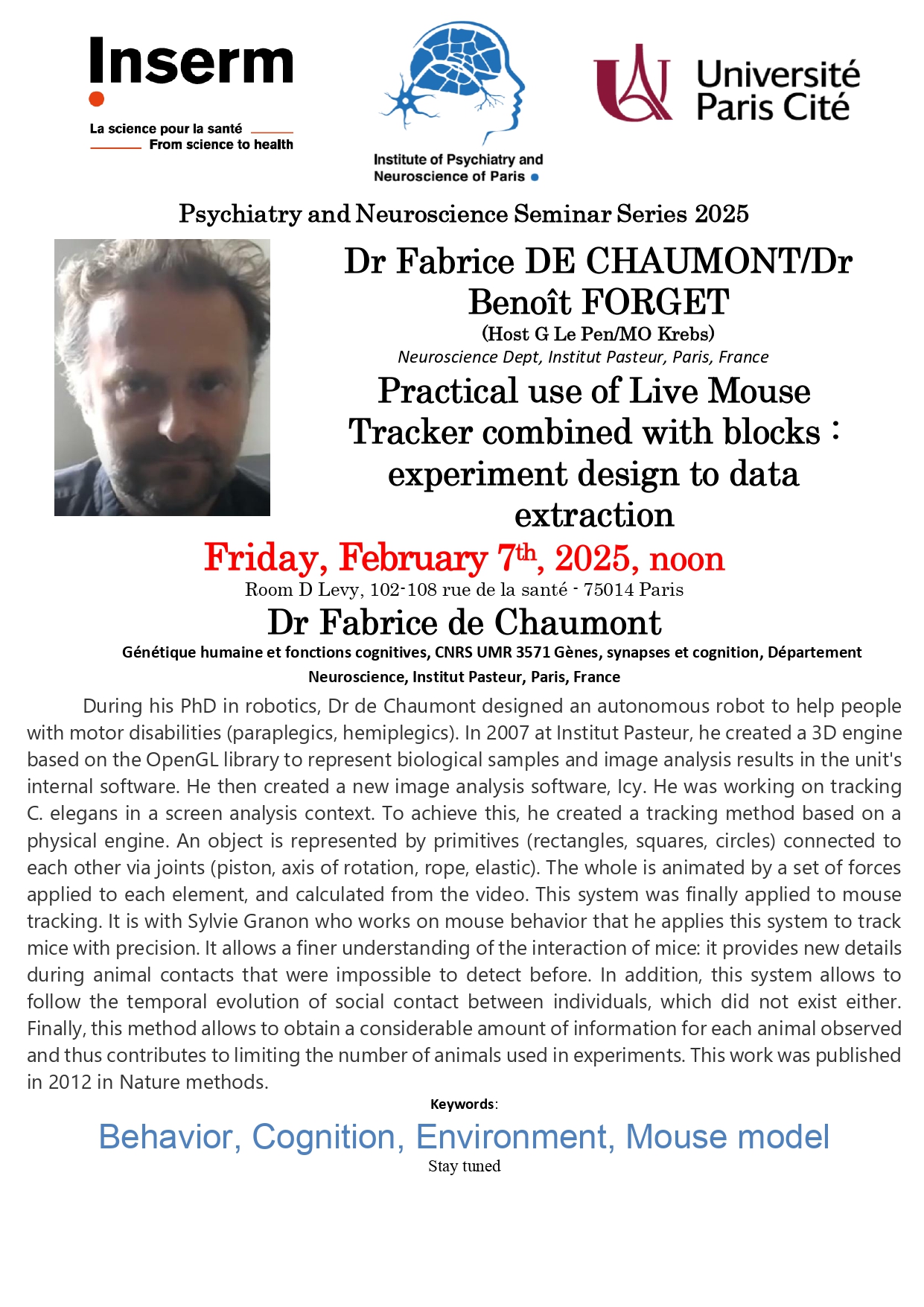
During his PhD in robotics, Dr de Chaumont designed an autonomous robot to help people with motor disabilities (paraplegics, hemiplegics). In 2007 at Institut Pasteur, he created a 3D engine based on the OpenGL library to represent biological samples and image analysis results in the unit's internal software. He then created a new image analysis software, Icy. He was working on tracking C. elegans in a screen analysis context. To achieve this, he created a tracking method based on a physical engine. An object is represented by primitives (rectangles, squares, circles) connected to each other via joints (piston, axis of rotation, rope, elastic). The whole is animated by a set of forces applied to each element, and calculated from the video. This system was finally applied to mouse tracking. It is with Sylvie Granon who works on mouse behavior that he applies this system to track mice with precision. It allows a finer understanding of the interaction of mice: it provides new details during animal contacts that were impossible to detect before. In addition, this system allows to follow the temporal evolution of social contact between individuals, which did not exist either. Finally, this method allows to obtain a considerable amount of information for each animal observed and thus contributes to limiting the number of animals used in experiments. This work was published in 2012 in Nature methods.
Behavior, Cognition, Environment, Mouse model
This part of the website could either be in French or English, depending on the sources of the actualities.